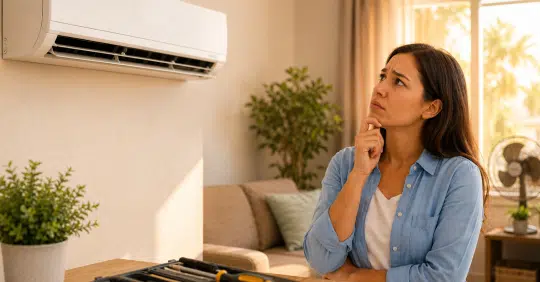
If your AC is not blowing cold air during a Southern California heat wave, you need answers fast. Temperatures across the Inland Empire regularly push past 100°F in summer, and a malfunctioning air conditioner turns your home from a refuge into an oven.
The good news? Many of the most common causes are straightforward. Some you can fix yourself in minutes. Others require a licensed HVAC technician. At Ramco Plumbing, Heating & Air, we’ve been diagnosing and repairing AC systems across Rancho Cucamonga and surrounding communities since 2005. Here are five issues we see most often, and what you can do about each one.
1. Dirty or Clogged Air Filters Are Restricting Airflow
A dirty air filter is the single most common reason your AC is not blowing cold air. The filter catches dust, pet hair, and debris before they reach your system’s internal components. Once it’s clogged, airflow drops significantly.
Reduced airflow forces your AC to work harder and run longer. That extra strain can freeze your evaporator coils, which stops cold air production entirely. We see this constantly in homes along Foothill Boulevard and throughout the Etiwanda and Terra Vista neighborhoods, especially during peak summer when systems run nonstop.
The fix is simple and cheap. Replace your air filter every one to three months, depending on usage. A standard replacement filter costs between $5 and $20 at any local hardware store. While you’re at it, check all supply vents and return registers throughout your home. Furniture, curtains, or closed vents can restrict airflow just as much as a dirty filter.
If you’ve replaced your filter and your AC still blows warm air, the problem likely runs deeper. Keep reading.
2. Thermostat Settings or Malfunctions Are Sending the Wrong Signals
Before assuming the worst, check your thermostat. It sounds obvious, but we get calls every week from homeowners whose AC isn’t blowing cold air simply because of a setting issue.
Here’s what to verify:
- Mode is set to “Cool”, not “Heat” or “Fan Only.”
- Fan setting is on “AUTO”, not “ON.” When the fan is set to “ON,” it runs continuously, even between cooling cycles. That means it blows room-temperature air when the compressor isn’t active, which feels like warm air.
- Temperature is set below the current room temperature, the system won’t kick on if the thermostat thinks the house is already cool enough.
Dead or dying batteries cause thermostat malfunctions too. If your display is blank or flickering, swap the batteries first. Programmable and smart thermostats can also lose their settings after a power outage, something that happens regularly during Inland Empire monsoon storms in late summer.
If your thermostat settings check out and the AC still won’t cool, the issue is mechanical. That’s when it’s time to look at your refrigerant levels.
3. Low Refrigerant Levels Point to a Leak
Refrigerant is the chemical compound your AC uses to absorb heat from indoor air. When refrigerant levels drop, your system can’t pull enough heat out of the air, and it blows warm instead of cold.
AC systems don’t consume refrigerant like a car burns fuel. If levels are low, you have a leak somewhere in the system, usually in the copper refrigerant lines, evaporator coil, or condenser coil. This isn’t a DIY repair. Refrigerant handling requires EPA certification, and topping off a leaking system without fixing the source wastes money and harms the environment.
Low refrigerant also raises indoor humidity, making your home feel even warmer than the thermostat reads. Over time, running a system with insufficient refrigerant damages the compressor, the most expensive component to replace.
How to Spot a Refrigerant Leak Early
Catch a refrigerant leak before it causes major damage by watching for these signs:
- Hissing or bubbling sounds near refrigerant lines, especially at connection points.
- Ice forming on the evaporator coil or refrigerant lines, a direct indicator of low charge.
- Your AC runs constantly but never reaches the set temperature.
- Higher-than-normal electric bills without a change in usage habits.
If you notice any of these, turn off your system and call an HVAC professional. Continuing to run an AC with a refrigerant leak compounds the damage and increases repair costs.
4. Frozen Evaporator Coils Are Blocking Cool Air Production
Frozen evaporator coils are a cause and a symptom. They directly block cool air from reaching your vents, but they also signal an underlying problem that needs attention.
Evaporator coils sit inside your indoor air handler and absorb heat from the air passing over them. When airflow drops, from a dirty filter, closed vents, or a failing blower motor, the coils get too cold and moisture on them freezes. Low refrigerant levels cause the same result through a different mechanism: reduced pressure drops the coil temperature below freezing.
You’ll know your coils are frozen if you see ice on the indoor unit or refrigerant lines, if airflow from your vents feels weak, or if water pools around your air handler as ice melts.
Here’s what to do: Turn your AC off and switch the fan to “ON” to circulate warm air over the coils. Let the ice thaw completely, this can take several hours. Once thawed, check your filter and replace it if it’s dirty. If the coils freeze again after restarting, the root cause is likely low refrigerant or a mechanical failure that requires professional diagnosis.
5. A Blocked or Dirty Condenser Unit Can’t Release Heat
Your outdoor condenser unit is where your AC dumps the heat it removed from inside your home. If that unit can’t release heat effectively, the whole system backs up and your AC blows warm air indoors.
Condenser coils collect dirt, grass clippings, leaves, and cottonwood fluff over time. Shrubs and landscaping can grow around the unit and choke airflow. We recommend maintaining at least two feet of clearance on all sides of your outdoor unit.
To clean your condenser, first shut off power to the unit. Remove any visible debris from around the base and the top grille. Gently spray the coil fins with a garden hose from the inside out, never use a pressure washer, which bends the delicate fins and creates more problems. Straighten any bent fins with a fin comb if needed.
A clean condenser with good airflow can improve your system’s efficiency by up to 15%. If you’ve cleaned the unit and your AC still isn’t blowing cold air, the compressor or condenser fan motor may be failing. That’s a job for a certified HVAC technician.
When to Call a Professional for AC Repair in Rancho Cucamonga
Some AC problems have quick DIY fixes. Replacing a filter or adjusting your thermostat takes minutes. But refrigerant leaks, frozen coils that keep recurring, compressor failures, and electrical issues all require a licensed professional.
Delaying service on a struggling system, especially during Rancho Cucamonga’s hottest months, often leads to larger breakdowns and higher bills.
At Ramco Plumbing, Heating & Air, we offer free in-home estimates with no obligation and upfront pricing before any work begins. Our technicians arrive within 60 to 90 minutes and are available 24/7 for emergencies. We’re a family-owned company founded right here in Rancho Cucamonga, and our 260+ five-star reviews reflect the honest, reliable service we’ve provided across the Inland Empire since 2005.
Whether your AC is not blowing cold air, making strange noises, or cycling on and off, give us a call. We also offer membership programs starting at $129 per year that include priority scheduling and maintenance to help prevent these problems before they start.
Consider it handled.